Live transcript · paid
On a paid plan, watch the words arrive as you speak. The final transcript presents speakers and timestamps for review.
Capture the conversation, review the transcript, shape a clinical note, work with patient documents, draft a letter, or record a meeting. Small Mercy keeps uncertainty visible and leaves clinical decisions with you.
Choose the plan that fits your day. View regional pricing.
Interactive illustration using a simulated consult. Hear the full synthetic example.
On a paid plan, watch the words arrive as you speak. The final transcript presents speakers and timestamps for review.
Uncertain words and unclear structure carry different flags. Re-read flagged text on Free; paid plans also offer listen-back for words Small Mercy wasn’t sure it heard.
Small Mercy currently uses Australian PBS/AMH drug names to recover garbled medication speech. Every proposed correction is visible and revertible.
Watch the medication example →Draft statements are checked against the transcript. Required content absent from the conversation appears as [not stated].
Laterality, doses and critical values receive extra advisory checks before confirmation. The clinician decides what belongs in the record.
Notes, letters and meeting minutes remain drafts until you review and explicitly confirm them.
Choose a note template, inspect the draft beside the transcript, edit it, and confirm. Follow-up tasks are surfaced for your review before they join your list.
Watch note review →Record a consented consult or dictate a note.
Compare draft and transcript, resolve flags and edit.
Save or export the reviewed result.
Paste text or upload a PDF, including a scan, into the patient chart on the web or desktop. The original stays the document of record. Small Mercy can draft an index for you to verify, edit or dismiss, so you can find the document again by list, timeline or category.
When you need a new document, choose its source documents. Small Mercy drafts from those sources, not an unverified summary. It shows conflicts, flags unsupported statements, and marks required gaps [not stated]. Your opinion and plan are yours to write. Nothing is exported until you confirm the draft.
“Admitted 9 Sep with cough and fever. Discharge diagnosis: pneumonia. Discharged 12 Sep. GP review within seven days.”
“Clinically improved at discharge. GP review in two weeks. Medicines: see medication chart.”
“Amoxicillin 500 mg orally three times daily until 17 Sep. Paracetamol 1 g orally up to four times daily as needed for pain.”
All three original files stay on the patient chart.
Admitted 9 Sep with cough and fever. Pneumonia is documented as the discharge diagnosis; discharged 12 Sep.
Discharge summaryWithin seven days in the discharge summary. In two weeks in the ward round note.
Discharge summaryWard round note[not stated]Illustrative workflow with fictional clinical content. The three originals remain the record; the case summary is a draft until the clinician reviews and confirms it.
More document types can be drafted; these seven have required-section checks. A patient plain-language summary is not included.
Draft from a consult or use voice dictation. Templates and completeness checks sit in one workflow; paid practices can configure letterhead and signatures. A draft remains unsent until you confirm it; export as PDF/A when ready.
Watch a letter take shape →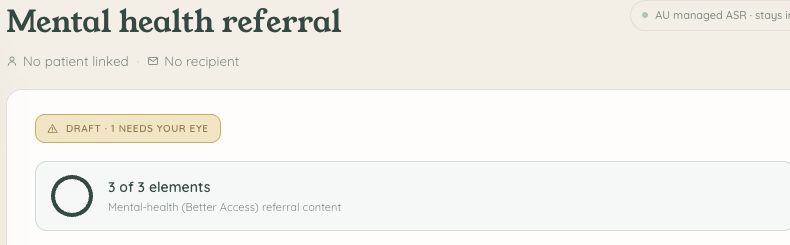
Real Small Mercy review screen with synthetic clinical data; cropped to the draft and completeness status.
Record a team discussion and review draft minutes, decisions and dated actions before saving. Use the same explicit confirmation flow for standalone letter dictation.
Watch the meeting example →How the team hands over follow-up tasks after a busy clinic.
Use a single handover checklist for outstanding patient calls.
Practice manager to circulate the draft checklist before the next huddle.
Illustrative interface with synthetic content. Decisions and actions remain drafts until reviewed and confirmed.
Cliniko and Nookal connect on paid plans for Australian and New Zealand practices. Today’s appointments come into Small Mercy, and once you have confirmed which patient a booking is, you start the consult from it. Once you confirm the note and check the patient a second time, Small Mercy files it into Cliniko or Nookal as a draft treatment note for you to finalise there — and reads it back before it says it was sent. A confirmed letter can be filed as a PDF copy on the patient’s record; you still send the letter itself. Nothing is written until you confirm and send. Everything else still exports as clean text and PDF you paste or attach: Best Practice, MedicalDirector, HealthLink, Medical Objects and My Health Record are on the roadmap, and we’ll say “integrated” only when it actually is.
See export and integration details →The web app, Windows and Mac desktop apps, iPhone and Apple Watch app, and Android app are all published. Clinical access is open in Australia, New Zealand and the United Kingdom. Free captures on web, iPhone and Android; paid adds desktop and watch capture.
Your organisation’s processing profile and consent rules follow the account across devices.
“Only what was said.”